RioLeaf Ltd. | Buyer Education Series — Article 03
Introduction: Why Yarn Count Matters in T-Shirt Manufacturing
Two cotton T-shirts can have the same fabric weight yet feel noticeably different. One may have a compact, smooth surface, while the other feels more open, flexible or textured.
These differences may come from the yarn, but yarn count alone rarely explains the complete result.
For apparel buyers, fabric weight is often one of the first specifications discussed with a manufacturer. A request for a 160 GSM, 180 GSM or 220 GSM cotton T-shirt is common. However, GSM does not tell the supplier everything about the yarn or knitted fabric structure.
The finished fabric also depends on knitting parameters, including stitch length, machine gauge and stitch density, as well as dyeing and finishing conditions.
This guide explains the English cotton count system (Ne), its relationship with GSM and how different knitting and finishing decisions influence T-shirt fabric performance.
1. What Is Yarn Count in Knit Fabric?
Yarn count is a numerical expression of yarn fineness or linear density.
Different yarn numbering systems are used across the textile industry. For cotton and many short-staple spun yarns, the English cotton count system, abbreviated Ne, is widely recognised.
Ne is an indirect numbering system:
- A lower Ne number indicates a coarser yarn.
- A higher Ne number indicates a finer yarn.
For example, 20 Ne cotton yarn is coarser than 30 Ne cotton yarn when both are compared on the same numbering basis.
Understanding English Cotton Count
In the English cotton count system, one hank equals 840 yards.
The yarn count expresses how many 840-yard lengths of yarn weigh one pound.
Ne = Yarn length in yards ÷ (840 × Yarn weight in pounds)
| Yarn Count | Length per Pound | Relative Fineness |
|---|---|---|
| 20 Ne | 16,800 yards | Coarser |
| 26 Ne | 21,840 yards | Intermediate |
| 30 Ne | 25,200 yards | Finer |
| 40 Ne | 33,600 yards | Finer than 30 Ne |
A finer yarn provides more length for the same weight.
However, yarn count does not independently establish yarn strength, evenness, hairiness or finished fabric quality.
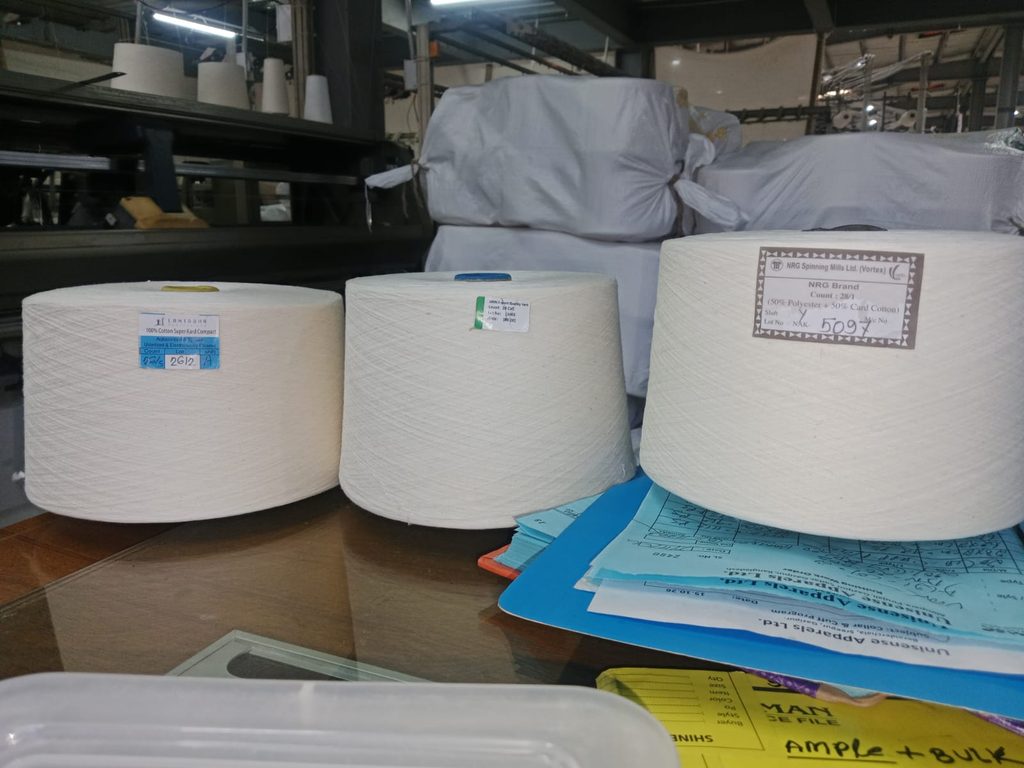
Buyer takeaway: Yarn count describes fineness. It does not automatically establish whether a finished T-shirt will be softer, stronger or more durable.
2. Understanding Common Cotton Yarn Counts
Cotton T-shirt manufacturing may involve different yarn counts depending on the intended fabric weight, knitting construction, product positioning and finishing process.
| Yarn Count | Relative Fineness | Development Consideration |
|---|---|---|
| 20 Ne | Coarser | May be considered for substantial knitted constructions |
| 24 Ne | Moderately coarse | An option for medium-to-heavier jersey development |
| 26 Ne | Intermediate | Can support a range of jersey constructions |
| 30 Ne | Finer | Often considered for finer jersey development |
| 40 Ne | Finer | May be suitable for lightweight or finer-gauge constructions |
These descriptions are comparative rather than fixed GSM specifications.
The same yarn count can produce different fabric weights when knitting parameters and processing conditions change.
What Do 26/S, 30/1 and 30/2 Mean?
In some garment-production environments, 26/S is used to describe a 26-count single yarn.
For international technical documentation, 26/1 Ne is often clearer, provided this matches the supplier’s actual yarn specification.
A 30/1 Ne yarn is a single yarn, while 30/2 Ne generally identifies a two-ply construction made from two 30-count component yarns.
These are not equivalent yarn constructions. Buyers should confirm the complete specification rather than comparing only the count number.
3. Yarn Count vs GSM: What Is the Difference?
Yarn count and GSM describe different properties.
Yarn count expresses yarn fineness or linear density.
GSM (grams per square metre) expresses fabric mass per unit area.
A fabric’s GSM depends on how much yarn is present within a square metre of fabric, together with the mass and dimensional changes associated with processing.
For knitted fabrics, important influences include:
- Yarn linear density
- Stitch length and loop geometry
- Courses and wales per unit length
- Fabric construction
- Fabric relaxation
- Dyeing and finishing
- Measurement and conditioning conditions
Why Finer Yarn Does Not Always Produce Lighter Fabric
Consider two hypothetical cotton single jersey fabrics.
| Parameter | Fabric A | Fabric B |
|---|---|---|
| Composition | 100% Cotton | 100% Cotton |
| Yarn Count | 26/1 Ne | 30/1 Ne |
| Fabric Construction | Single Jersey | Single Jersey |
| Finished GSM | 180 | 180 |
| Knitting Parameters | Adjusted for target | Adjusted for target |
Both fabrics may achieve the same finished GSM through different knitting constructions and finishing conditions.
Their surface appearance, thickness, flexibility and hand feel may nevertheless differ.
These are illustrative possibilities, not measured RioLeaf production results.
For buyers, this demonstrates why GSM should not be treated as a complete description of fabric quality or construction.
4. How Knitting Construction Influences Fabric Weight and Feel
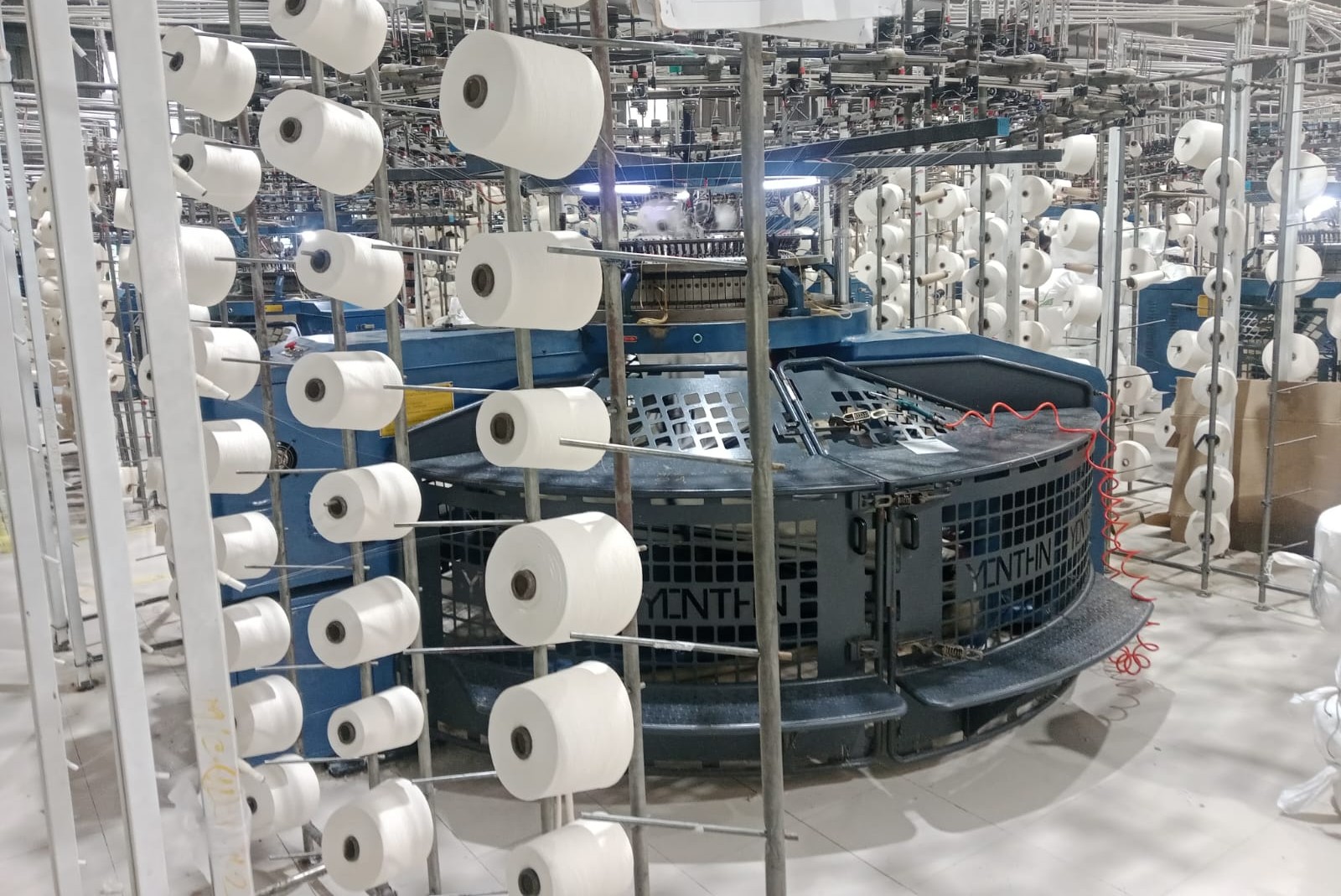
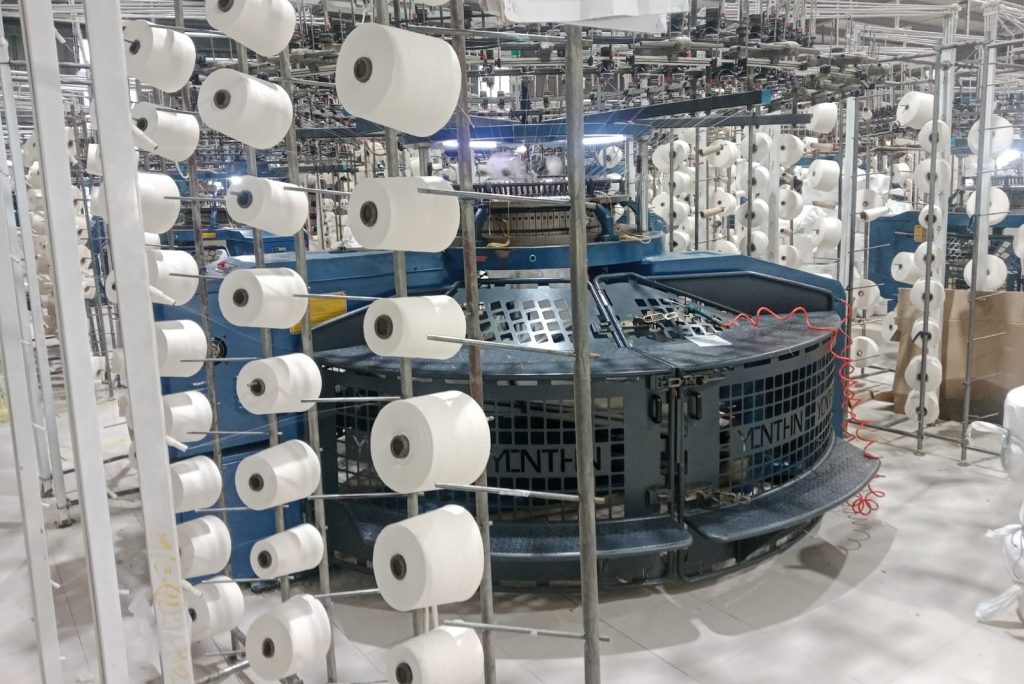
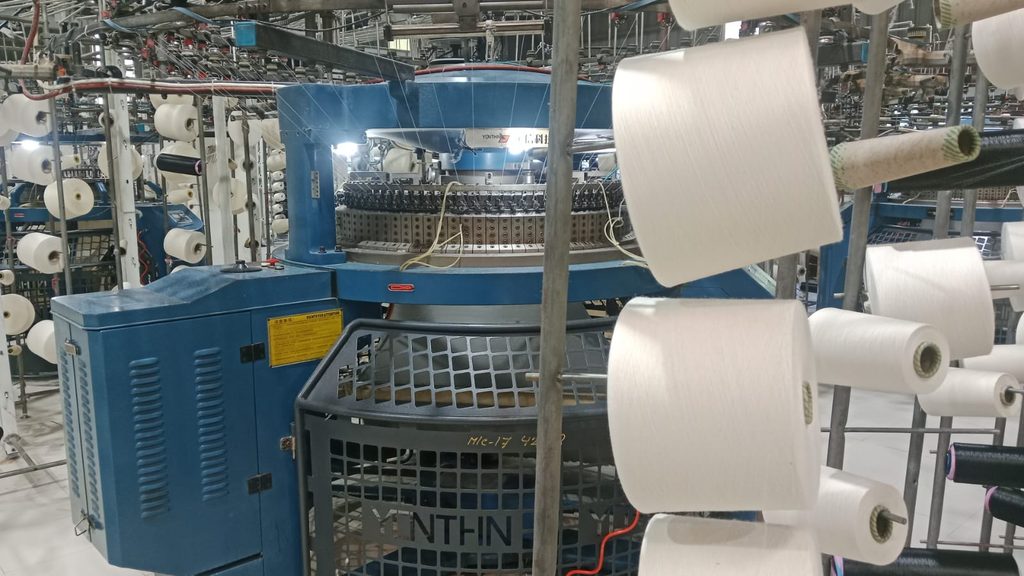
Knitting machines produce fabric by forming interconnected yarn loops.
The size and arrangement of these loops influence the amount of yarn contained within a given fabric area.
Three parameters deserve particular attention.
4.1 Stitch Length
Stitch length describes the approximate length of yarn used to form a knitted loop.
Under comparable knitting and relaxation conditions, shorter stitch lengths generally produce smaller loops and a more compact fabric structure.
Longer stitch lengths generally produce larger loops and a more open structure.
Changing stitch length can influence fabric weight, extensibility, appearance and dimensional behaviour.
However, the exact effect depends on stitch density, loop geometry and subsequent processing.
4.2 Machine Gauge
Machine gauge describes the number of needles per inch in the machine’s needle arrangement.
For example, a 28-gauge machine has more needles per inch than a 24-gauge machine.
Gauge influences the yarn sizes and knitting constructions that can be processed appropriately.
A higher machine gauge does not automatically produce higher GSM or better fabric quality.
Gauge and yarn count should be selected together according to the required fabric structure.
4.3 Fabric Structure
Single jersey, rib and interlock are different knitted constructions.
They use yarn in different loop arrangements and can produce different fabric characteristics.
Single jersey commonly has visibly different face and back surfaces, while 1×1 rib has alternating knit and purl wales that contribute to widthwise extensibility.
Two fabrics with the same yarn count and GSM may therefore differ in thickness, stretch, appearance and recovery behaviour.
Buyers should specify the fabric construction alongside yarn count and finished GSM.
4.4 Practical Example: Same 26/S Cotton Yarn, Different GSM
One common misunderstanding in T-shirt sourcing is that a particular yarn count should always produce a particular fabric weight.
In reality, the same yarn count can be used to develop fabrics with different GSM values.
Example A: Simplified Scientific Illustration
Consider two hypothetical single jersey fabrics using the same 26/1 Ne cotton yarn on 24-gauge knitting machines.
| Parameter | Fabric A | Fabric B |
|---|---|---|
| Yarn Count | 26/1 Ne | 26/1 Ne |
| Construction | Single Jersey | Single Jersey |
| Machine Gauge | 24G | 24G |
| Stitch Length | 2.85 mm | 2.75 mm |
| Illustrative Greige GSM | 140 | Approximately 145 |
The GSM figures are illustrative estimates, not verified production measurements.
For a simplified relaxed single jersey model, with yarn linear density and other relevant construction conditions held constant, fabric GSM may be approximated as inversely proportional to stitch length.
Estimated GSM relationship:
GSM B / GSM A ≈ Stitch Length A / Stitch Length B
= 2.85 / 2.75
≈ 1.0364
This corresponds to an approximate 3.64% increase.
If Fabric A has a greige GSM of 140, the simplified estimate for Fabric B becomes:
140 × 1.0364 ≈ 145 GSM.
This is a conceptual calculation, not a formula that can predict exact production GSM.
Actual results depend on stitch density, fabric relaxation, machine settings and measurement conditions.
Example B: RioLeaf White Cotton Production Reference
RioLeaf Ltd. has reported the following production information for white cotton knitted fabric.
| Technical Parameter | Fabric A | Fabric B |
|---|---|---|
| Yarn Count | 26/S Cotton | 26/S Cotton |
| Colour | White | White |
| Machine Gauge | 24G | 24G |
| Reported Stitch Length | 2.85 mm | 2.75 mm |
| Reported Greige GSM | 135–140 | 155–160 |
| Reported Finished GSM | 160 | 180 |
Production Note: These figures represent reported white cotton fabric production conditions. The difference in greige GSM cannot be attributed to stitch length alone without reviewing actual stitch density, machine settings, fabric relaxation and measurement conditions.
Source: RioLeaf Ltd. reported white-fabric production information. The figures have not been independently verified against complete knitting and finishing records.
The reported fabrics have different greige and finished GSM values despite using the same nominal yarn count and gauge.
However, the relatively large difference in greige GSM cannot confidently be explained by the reported stitch-length change alone.
Other variables—including actual stitch density, fabric dimensions, machine configuration, relaxation conditions and measurement procedures—would need to be reviewed before identifying the complete cause.
This production reference should therefore not be interpreted as a controlled experiment in which stitch length was the only changing variable.
It also applies specifically to the reported white-fabric processing conditions.
Buyer takeaway: Yarn count, gauge and stitch length are important, but a reliable fabric specification must also account for construction, finishing and measured results.
5. How Fabric Colour, Dyeing and Finishing Affect Final GSM
Fabric colour itself does not determine GSM.
However, the preparation, dyeing and finishing processes used to achieve a particular colour can influence the final fabric’s mass per unit area.
This distinction is important when buyers order the same T-shirt style in white, black, navy or other colours.
White Fabric vs Dark-Coloured Fabric
White cotton fabric may undergo preparation and bleaching to achieve the required appearance.
Black or navy cotton fabric may follow different dyeing, washing and finishing routes.
Depending on the material and process, these operations may change fabric dimensions, mass and relaxation behaviour.
Consequently, two fabrics knitted using similar yarn and machine settings may not have identical finished GSM values after different processing routes.
However, darker fabric should not automatically be assumed to have higher GSM than white fabric.
The actual result must be established through measurement.
Greige GSM vs Finished GSM
Greige GSM refers to fabric mass per unit area measured before the relevant wet-processing and finishing stages.
Finished GSM refers to the fabric after the agreed finishing process, measured under specified conditions.
The values can differ because fabric dimensions and mass may change during processing.
When fabric area decreases relative to its mass, GSM increases.
For example, fabric relaxation and compacting may alter width and length, affecting mass per square metre.
The final outcome also depends on other processing and measurement conditions.
Why Finishing Must Be Part of the Specification
For a finished T-shirt programme, buyers should confirm:
- Whether the quoted GSM refers to greige or finished fabric.
- The agreed finished GSM tolerance.
- The fabric colour and finishing requirements.
- The relevant dimensional stability criteria.
- The agreed measurement and conditioning method.
A white-fabric knitting reference should not automatically be used as a fixed prediction for another colour.
Buyer takeaway: Colour, dyeing and finishing should be considered part of fabric development, not merely appearance-related decisions.
6. How Yarn Count Can Influence T-Shirt Quality
Yarn count contributes to fabric characteristics, but its effects should be evaluated together with fibre quality, yarn preparation, knitting and finishing.
Fabric Surface and Appearance
Finer yarns can be used to develop finer fabric surfaces under suitable knitting conditions.
However, a higher Ne value does not guarantee a smoother appearance.
Yarn hairiness, evenness, fibre properties and finishing also influence the surface.
Hand Feel and Comfort
The hand feel of a T-shirt depends on surface friction, flexibility, thickness, fibre characteristics and finishing.
Yarn count contributes to these properties but does not independently measure softness.
A buyer seeking a particular hand feel should approve an actual fabric standard.
Strength and Durability
Yarn strength depends on fibre properties, spinning conditions, twist and yarn structure.
Finished fabric performance also depends on knitting construction and processing.
A finer yarn is not automatically stronger or weaker in every application.
For garments expected to withstand repeated wear and laundering, appropriate performance testing is more useful than assumptions based on yarn count.
Printing and Embroidery
Yarn count and fabric construction influence the surface presented to a print or embroidery process.
Printing quality also depends on artwork, ink system, pretreatment, curing and processing conditions.
Embroidery quality depends on design density, stabilisation and suitability of the base fabric.
Buyers should approve production-representative decoration samples.
7. How to Choose Yarn Count for a Custom T-Shirt
There is no single best yarn count for every cotton T-shirt.
A practical development process begins with the intended finished product.
Step 1: Define the Product
Clarify whether the garment is intended to be a lightweight everyday T-shirt, substantial oversized style, promotional garment or premium private-label product.
The intended appearance, comfort, durability and target cost should guide development.
Step 2: Confirm Fabric Construction
Specify single jersey, rib, interlock or another required construction.
This affects the available yarn and knitting options.
Step 3: Establish Finished GSM
Set a target finished GSM with an agreed tolerance and measurement method.
Avoid treating GSM as a substitute for the complete fabric specification.
Step 4: Review Yarn Options
Discuss appropriate yarn counts with the manufacturer.
Where relevant, confirm whether the yarn is carded, combed, compact-spun or produced through another spinning process.
These distinctions should be evaluated separately from yarn count.
Step 5: Approve Fabric Samples
Compare actual fabric swatches for appearance, hand feel, thickness, extensibility and decoration suitability.
Retain an approved physical reference sample wherever practical.
Step 6: Confirm Testing Requirements
Agree on the required tests, acceptance criteria and inspection approach before bulk production.
Clear specifications reduce the risk of disagreements arising from descriptions such as “premium cotton” or “soft finish.”
8. Fabric Testing: What Buyers Should Verify
Yarn count and GSM provide useful specifications, but neither guarantees finished garment performance.
Depending on the product and buyer requirements, a testing programme may include:
| Property | Purpose |
|---|---|
| Fabric Mass per Unit Area | Confirm finished GSM |
| Dimensional Change | Assess shrinkage or growth after laundering |
| Pilling Resistance | Evaluate surface pilling behaviour |
| Colour Fastness | Assess colour performance under specified conditions |
| Fabric Appearance | Compare surface and finishing against an approved standard |
| Garment Measurements | Confirm finished fit and dimensional tolerances |
Testing methods and acceptance limits should be agreed with the buyer.
Results should be evaluated in relation to the actual fabric, intended use and applicable test procedure.
9. Practical Fabric Specification Checklist for Buyers
Before approving a cotton T-shirt for bulk production, buyers should confirm:
- Product type and intended fit
- Fabric composition
- Yarn count and yarn construction
- Yarn preparation or spinning method, where relevant
- Knitted fabric structure
- Approved knitting construction or reference sample
- Target finished GSM and tolerance
- Fabric colour and finishing requirements
- Shrinkage and dimensional stability criteria
- Required colour fastness and pilling performance
- Printing or embroidery requirements
- Approved fabric and garment samples
- Testing, inspection and acceptance requirements
Not every order requires the same level of testing or documentation.
The objective is to define enough information for the manufacturer to reproduce the approved product consistently.
10. What This Means for Apparel Sourcing
Yarn count should be treated as one component of fabric engineering—not as a shortcut for judging quality.
A higher Ne value means a finer yarn within the English cotton count system. It does not automatically mean a better T-shirt.
Similarly, GSM does not fully describe fabric construction, feel or performance.
For apparel buyers, the more useful question is whether the selected yarn, knitting construction and finishing process can consistently deliver the approved fabric specification.
A well-prepared technical brief allows the buyer and manufacturer to discuss realistic options before committing to bulk production.
Frequently Asked Questions
Is 30 Ne cotton better than 20 Ne cotton?
Not necessarily. A 30 Ne yarn is finer than a 20 Ne yarn, but suitability depends on the intended fabric construction, garment design and performance requirements.
Can 26/S cotton yarn produce different GSM fabrics?
Yes. Different knitting constructions, stitch lengths, stitch densities and finishing conditions can produce different GSM values using the same nominal yarn count.
Does a shorter stitch length always increase GSM?
Under comparable conditions, shorter stitch lengths commonly produce a more compact structure and can increase GSM. The exact relationship depends on loop geometry, stitch density, relaxation and processing.
Does higher machine gauge mean higher GSM?
No. Gauge influences needle arrangement and knitting possibilities, but finished GSM depends on the complete construction and processing conditions.
Does black cotton fabric always have higher GSM than white cotton fabric?
No. Colour alone does not determine GSM. Differences in dyeing, washing, finishing and dimensional changes may influence the measured result.
Why is finished GSM different from greige GSM?
Fabric mass and dimensions can change during wet processing, drying, relaxation and finishing. These changes can alter mass per square metre.
Does higher yarn count mean softer fabric?
No. Yarn fineness can contribute to fabric characteristics, but softness also depends on fibre quality, yarn structure, knitting and finishing.
Should buyers specify both yarn count and GSM?
Where yarn construction matters to the approved product, specifying both can improve clarity. Buyers should also define fabric structure, finishing requirements and relevant tolerances.
Conclusion
Yarn count is an important technical parameter, but it should never be evaluated in isolation.
Understanding the difference between yarn fineness and fabric weight helps buyers avoid assumptions during T-shirt development.
When yarn count is considered alongside stitch length, machine gauge, fabric construction, colour and finishing, sourcing decisions become more precise.
For custom apparel programmes, the strongest starting point is a clear technical specification supported by physical samples and agreed quality requirements.
Technical References
- CottonWorks — English Cotton Count. Explains the English cotton count (Ne) system, including the relationship between yarn fineness and the number of 840-yard hanks per pound.
- CottonWorks — Yarn Ply, Counts and Treatments. Provides guidance on yarn numbering systems, single and plied yarns, and related terminology.
- CottonWorks — Knit Basics. Explains fundamental knitted fabric structures, stitch formation, stitch length and related knitting terminology.
- ASTM International — ASTM D3776/D3776M-20(2025): Standard Test Methods for Mass Per Unit Area (Weight) of Fabric. Identifies standard methods for measuring fabric mass per unit area.
Manufacturing Reference
RioLeaf Ltd. — White Cotton Knitting Production Reference. Internal production information concerning 26/S cotton yarn, 24-gauge knitting, reported stitch lengths and greige/finished GSM values.
The RioLeaf figures are reported production references, not independently verified laboratory findings. The simplified stitch-length calculation in this article is illustrative and should not be interpreted as an exact production prediction.
Mention of an ASTM test method does not imply that RioLeaf Ltd. holds ASTM certification or that the reported production measurements were obtained using that method.
Editorial note: This article provides general technical guidance. The simplified stitch-length calculation is illustrative. RioLeaf’s reported production figures have not been independently verified against complete machine and finishing records. The examples are not guaranteed production specifications.
Planning Your Next Custom T-Shirt Order?
RioLeaf Ltd. supports apparel brands, wholesalers, importers and private-label businesses with custom knit garment manufacturing.
Share your fabric composition, yarn count, target GSM, design and estimated quantity. RioLeaf Ltd. can review your requirements and discuss suitable manufacturing options.
COMING NEXT | BUYER EDUCATION SERIES — ARTICLE 04
Understanding Single Jersey Fabric: Stitch Length, Machine Gauge and Fabric Performance
Our next technical guide will examine how single jersey construction affects fabric weight, appearance, extensibility and finished T-shirt performance.
Publication date to be confirmed.