Buyer Education Series — 01 | RioLeaf Ltd.
Two T-shirts can both carry a “100% Cotton” composition label, yet perform differently after repeated wearing and washing. One may maintain a smoother surface, more consistent dimensions and better overall appearance, while another may develop excessive fuzziness, shrinkage or visible distortion.
Why does this happen?
Fiber quality is one important factor, but it is not the only one. Yarn selection, knitting construction, dyeing, finishing, garment manufacturing and testing all contribute to the performance of the finished T-shirt.
For apparel buyers, sourcing managers and private-label clothing brands, understanding these relationships helps establish more meaningful product specifications and quality expectations.
This guide explains the role of cotton fiber properties in T-shirt manufacturing, the limitations of fiber quality alone, and the checks buyers should consider before confirming bulk production.
1. Why a 100% Cotton Label Does Not Guarantee Identical Quality
A fabric composition label identifies the materials used, not the complete quality or performance of the fabric.
Two 100% cotton single jersey fabrics may differ in:
- Cotton fiber characteristics and yarn preparation
- Yarn count, twist and hairiness
- Knitting gauge, stitch length and fabric density
- Fabric weight (GSM) and finishing
- Dyeing quality and dimensional stability
- Pilling resistance, colorfastness and garment workmanship
Even when two T-shirts have the same GSM, they may not have the same hand feel, surface appearance or washing performance.
Buyer takeaway: Cotton composition and GSM are useful starting points, but they should not be treated as complete quality specifications.
2. Four Important Cotton Fiber Properties
2.1 Fiber Length
Cotton staple length refers to the length of the individual cotton fibers.
Longer and more consistent fibers can support better yarn formation, depending on the spinning system and processing conditions. They may help produce yarn with improved strength and fewer protruding fiber ends.
However, longer fiber does not automatically guarantee a superior finished T-shirt. Yarn engineering, fabric construction and finishing remain essential.
What buyers should consider: Ask whether the proposed yarn and fabric construction are appropriate for the required surface quality, durability and price level.
2.2 Fiber Strength
Fiber strength influences how cotton performs during spinning and contributes to the strength potential of the yarn.
Stronger fibers can help support yarn integrity, but finished garment durability also depends on yarn count, twist, knitting construction, fabric finishing and seam quality.
What buyers should consider: For products requiring durability, evaluate relevant yarn or fabric strength performance rather than relying only on a general claim of high-quality cotton.
2.3 Fiber Uniformity
Cotton fiber uniformity describes the consistency of fiber lengths within a sample.
Poor length uniformity and a higher proportion of short fibers can create additional processing challenges. Depending on the yarn preparation method, they may contribute to irregularity and hairiness.
More consistent raw materials can support better process control, although final results still depend on spinning and fabric production.
What buyers should consider: Evaluate yarn evenness and fabric appearance through approved samples and measurable quality requirements.
2.4 Micronaire
Micronaire is a cotton fiber measurement influenced by both fineness and maturity.
It is sometimes misunderstood as a direct measurement of softness. In reality, micronaire does not independently determine how soft a T-shirt will feel.
Cotton with unsuitable fiber characteristics can create processing and dyeing challenges, but fabric softness is also strongly influenced by yarn, knitting, chemical treatment and finishing.
What buyers should consider: Avoid selecting cotton based on a single micronaire value without considering the overall fiber profile and intended manufacturing process.
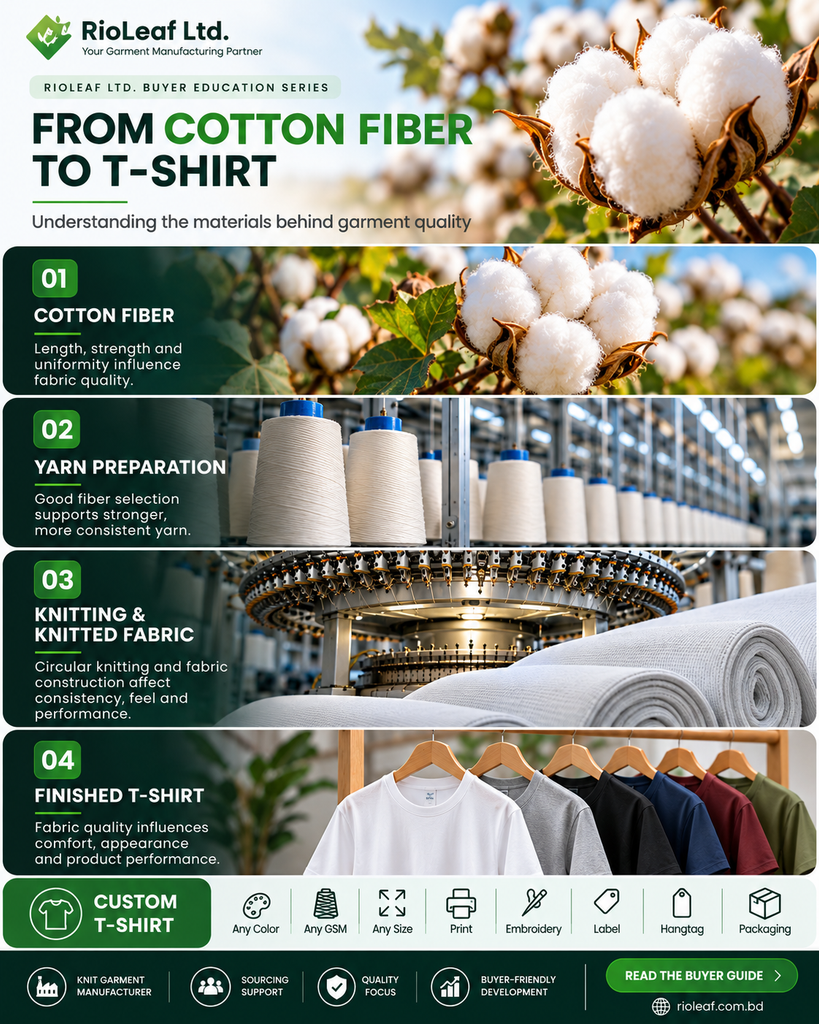
3. From Cotton Fiber to Finished T-Shirt
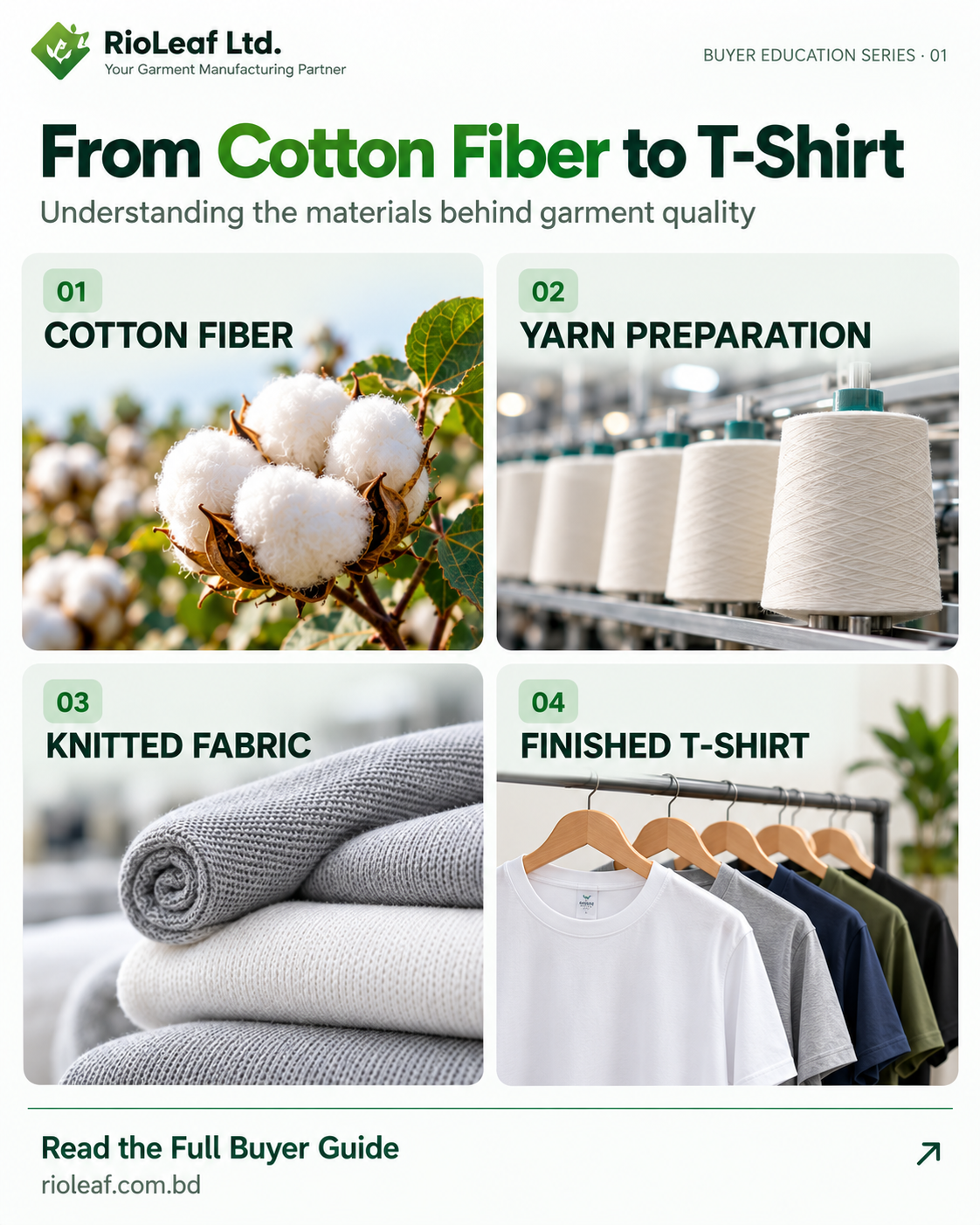
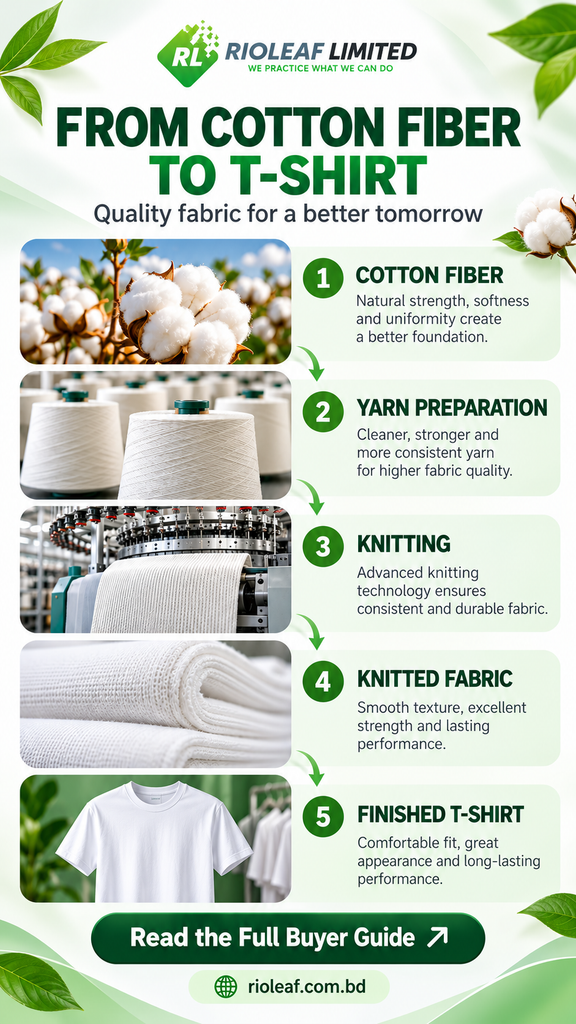
The journey from raw cotton to a finished garment involves several connected stages.
Stage 1 — Cotton Fiber Selection
Raw cotton is evaluated and selected according to the yarn and fabric requirements.
Important characteristics may include staple length, strength, uniformity, micronaire, color and contamination.
Stage 2 — Yarn Preparation and Spinning
Cotton is processed into yarn through operations that may include opening, cleaning, carding, optional combing, drawing and spinning.
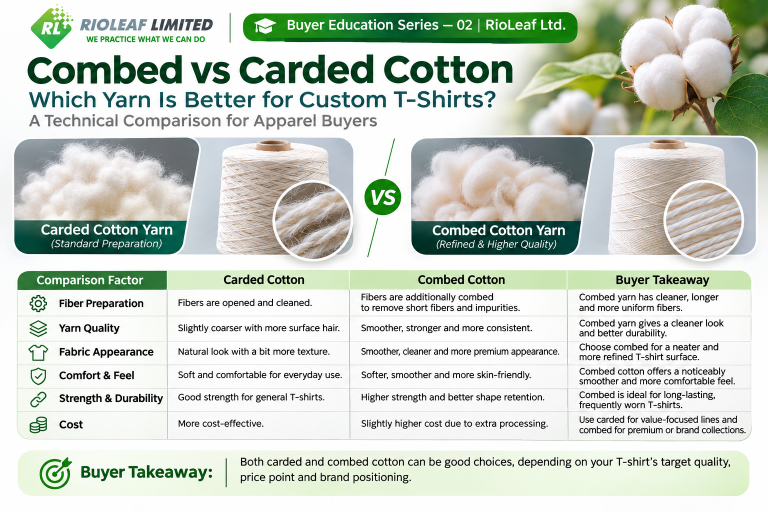
Carded and combed yarns can both be suitable for T-shirt production. Their selection depends on product positioning, target fabric appearance, performance requirements and cost.
Stage 3 — Knitted Fabric Construction
Yarn is converted into knitted fabric, commonly single jersey for basic T-shirts.
Yarn count, stitch length, knitting settings and fabric density influence the fabric’s weight, stretch, appearance and dimensional behavior.
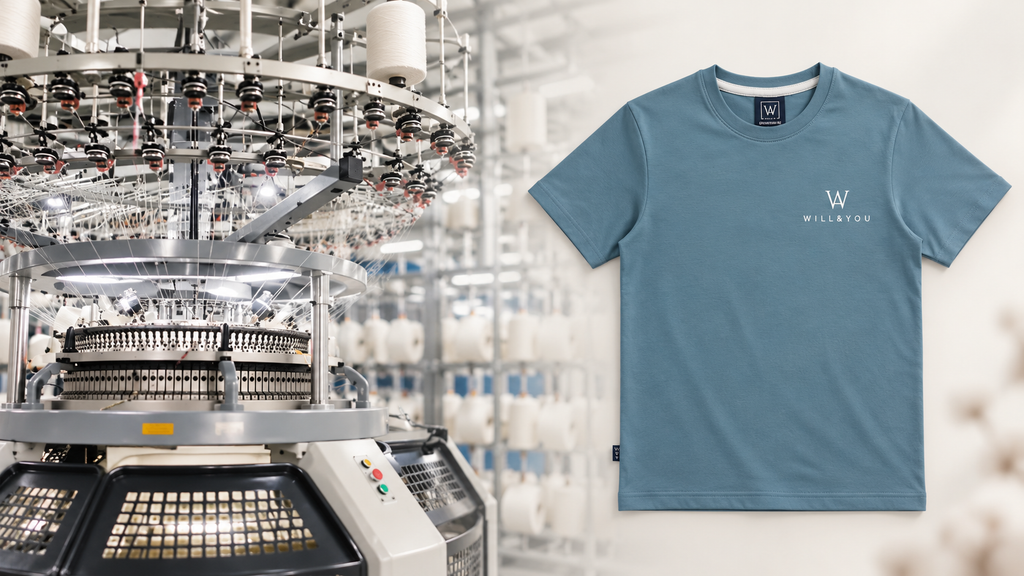
Inside the Knitting Process: From Yarn to Fabric
Circular knitting transforms yarn into knitted fabric through the formation of interconnected loops. Yarn count, stitch length, machine settings and fabric density influence the resulting fabric’s structure, appearance, stretch and dimensional behavior.
Watch the following RioLeaf Ltd. factory video to explore yarn feeding, loop formation and continuous knitted fabric production.
Video: RioLeaf Ltd. | Buyer Education Series 01
Stage 4 — Dyeing and Finishing
Dyeing, washing, drying, compacting and other finishing operations influence color, surface feel and dimensional stability.
Proper process control is essential because a suitable cotton yarn can still produce disappointing results if the fabric is poorly processed.
Stage 5 — Cutting, Sewing and Final Inspection
Fabric relaxation, pattern allowances, cutting accuracy, sewing quality and final inspection all affect the finished T-shirt.
A technically appropriate fabric must still be converted into a garment with consistent measurements and workmanship.
Buyer takeaway: Quality must be controlled throughout the supply chain, not assessed only at the raw cotton stage.
4. How Fiber and Fabric Quality Affect T-Shirt Performance
4.1 Surface Appearance and Pilling
Pilling occurs when loose or protruding fibers become entangled on the fabric surface during friction and wear.
Fiber characteristics, yarn hairiness, fabric structure and finishing can all influence the development and retention of pills.
Combed yarn may offer a cleaner surface in some applications, but combing alone does not guarantee a particular pilling grade.
For bulk orders, buyers should specify an appropriate pilling test method and acceptance level.
4.2 Shrinkage and Dimensional Stability
Cotton knit fabrics may change dimensions after laundering because of yarn and fabric relaxation, processing history and washing conditions.
The result depends on fabric construction, finishing, garment processing and the care procedure used.
Pre-shrinking or compacting can improve dimensional stability, but no treatment should be assumed to eliminate all subsequent shrinkage.
A commonly requested tolerance in some T-shirt programs is approximately ±3%, but this is not a universal acceptance standard. The contractual tolerance should be agreed with the buyer and verified using the specified test method.
Dimensional change after laundering may be evaluated using ISO 5077, together with an appropriate washing and drying procedure such as ISO 6330. The required acceptance tolerance, number of wash cycles and testing conditions should be agreed upon with the buyer before bulk production.
4.3 Fabric Strength and Durability
Cotton fiber strength contributes to yarn performance, but the durability of a T-shirt also depends on the fabric structure, finishing and garment construction.
A heavier fabric is not necessarily more durable in every respect.
Buyers should assess performance against the garment’s intended use rather than assuming that a higher GSM automatically means better quality.
4.4 Color Consistency and Colorfastness
Cotton fiber characteristics and preparation can affect dyeing behavior. However, color consistency also depends on pretreatment, dye selection, process control and finishing.
Relevant tests may include colorfastness to washing, rubbing and perspiration, depending on the product and buyer requirements.
A visually attractive sample is not sufficient evidence that bulk production will maintain the same color performance.
4.5 Comfort and Hand Feel
Comfort is influenced by multiple characteristics, including fiber properties, yarn structure, fabric weight, air permeability, moisture behavior, finishing and garment fit.
A soft-touch finish may improve initial hand feel, but buyers should also consider whether that feel remains acceptable after laundering.
Buyer takeaway: Evaluate the finished garment against its intended market, not just the raw material description.
5. Why GSM Alone Is Not Enough
GSM means grams per square meter and indicates fabric mass per unit area.
It is useful for describing fabric weight, but it does not independently establish softness, yarn quality, durability, pilling resistance or shrinkage.
For example, two 200 GSM cotton single jersey fabrics may have different yarn counts, knitting densities, finishing treatments and washing results.
A stronger sourcing specification combines GSM with other requirements, such as:
| Specification | What Buyers Should Define |
|---|---|
| Fabric composition | Cotton percentage and any blended fibers |
| Fabric construction | Single jersey, interlock, rib or other structure |
| Yarn | Count, spinning type and carded/combed selection where relevant |
| GSM | Target weight and agreed tolerance |
| Shrinkage | Test procedure and dimensional-change tolerance |
| Pilling | Test method and acceptance grade |
| Colorfastness | Relevant tests and minimum grades |
| Measurements | Approved size chart and tolerances |
| Workmanship | Approved sample and inspection criteria |
The exact specification should reflect the product’s end use, market and price positioning.
6. A Practical Quality Checklist for Apparel Buyers
Before confirming a custom T-shirt bulk order, consider the following checks:
Fabric development
- Confirm composition, construction, yarn requirements and GSM.
- Review fabric hand feel and surface appearance.
- Agree on the target color and approved color standard.
Sample evaluation
- Check fit, garment measurements and stitching.
- Review print or embroidery appearance, where applicable.
- Conduct washing evaluation under an agreed care procedure.
Performance testing
- Define shrinkage and dimensional stability requirements.
- Select relevant pilling and colorfastness tests.
- Add other tests where required by the product or destination market.
Bulk production control
- Approve a representative pre-production sample.
- Confirm acceptable tolerances and inspection procedures.
- Check production consistency against the approved specification.
These steps help reduce misunderstandings between buyers and manufacturers.
7. How RioLeaf Approaches Custom T-Shirt Development
RioLeaf Ltd. is a Bangladesh-based garment manufacturer and exporter providing OEM/ODM services for international apparel buyers, clothing brands, wholesalers and private-label businesses.
For custom T-shirt programs, product development can include fabric composition, GSM, fit, color, printing, embroidery, labels and packaging according to the buyer’s approved requirements.
Both carded and combed cotton yarns can be considered depending on the intended product, fabric specification and commercial requirements.
Our approach is to discuss technical expectations during product development and confirm practical requirements through samples, specifications and agreed quality controls.
Testing and certification requirements should be confirmed for each order. No particular test result or certification should be assumed without supporting evidence.
8. Frequently Asked Questions
Is 100% cotton always better quality than cotton blends?
No. Composition alone does not establish overall quality. Cotton and blended fabrics serve different performance and cost requirements.
Does longer cotton fiber always produce a better T-shirt?
Not necessarily. Longer fibers can offer advantages in suitable yarn systems, but yarn processing, knitting and finishing also influence the finished garment.
Is combed cotton always better than carded cotton?
No. Combed cotton can support a smoother, more uniform yarn, but both types have appropriate applications. Selection should be based on the target product and specification.
Does higher GSM mean better cotton quality?
No. GSM measures fabric weight, not cotton fiber quality or overall garment performance.
Can a pre-shrunk cotton T-shirt still shrink?
Yes. Pre-shrinking and compacting may reduce dimensional change, but residual shrinkage can still occur. Performance should be tested using the agreed washing and drying procedure.
What should buyers test before bulk T-shirt production?
Depending on the product, buyers may evaluate dimensional stability, pilling, colorfastness, fabric properties, fit and workmanship. The test methods and acceptance levels should be agreed before production.
9. Final Thoughts
A reliable T-shirt sourcing decision requires more than checking a composition label or selecting a fabric weight.
Cotton fiber length, strength, uniformity and micronaire influence the starting material, while spinning, knitting, dyeing, finishing and garment construction determine how those characteristics translate into the final product.
For international buyers, the most effective approach is to define measurable requirements, review representative samples and verify performance before bulk production.
Looking for custom T-shirt manufacturing in Bangladesh?
Contact RioLeaf Ltd. to discuss your fabric requirements, product specifications, sampling and OEM/ODM development needs.
Website: https://rioleaf.com.bd/
Technical References
The following standards provide useful reference points for defining or evaluating relevant textile properties. Applicable editions and test conditions should be confirmed before use.
- ISO 5077 — Textiles: Determination of dimensional change in washing and drying.
- ISO 6330 — Textiles: Domestic washing and drying procedures for textile testing.
- ISO 12945 series — Textiles: Determination of fabric propensity to surface pilling, fuzzing or matting.
- ISO 105-C06 — Textiles: Tests for colour fastness to domestic and commercial laundering.
- ISO 105-X12 — Textiles: Tests for colour fastness to rubbing.
These references describe testing frameworks; they do not establish a universal pass/fail grade for every T-shirt product.