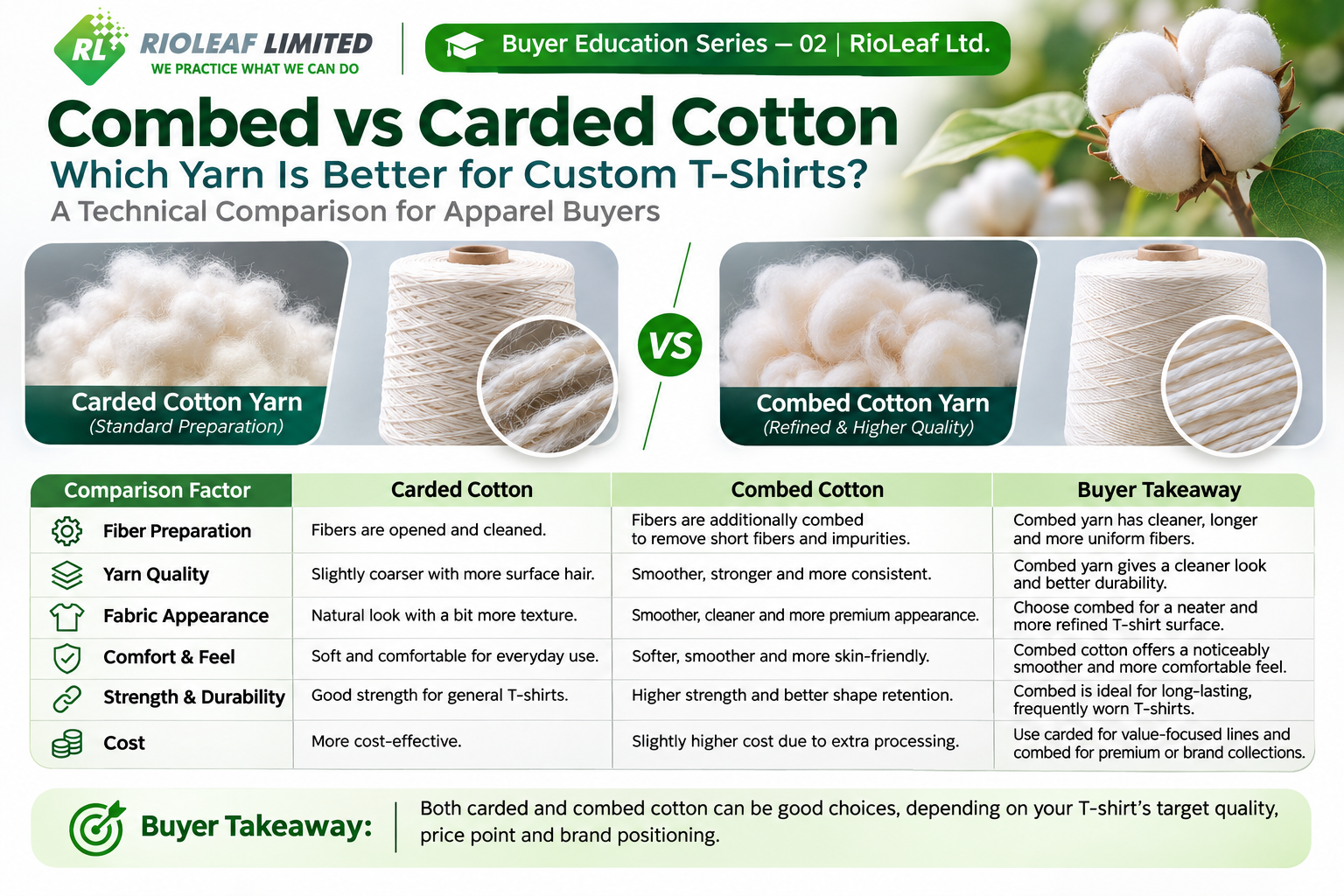
Buyer Education Series — 02 | RioLeaf Ltd.
← Explore All Buyer Education Articles
A Technical Sourcing Guide for Apparel Buyers, Product Developers and Private-Label Clothing Brands
Introduction: Why Yarn Selection Matters Before T-Shirt Production
When sourcing custom cotton T-shirts, buyers frequently compare fabric composition, GSM, fit, printing quality and unit price. Yet one of the most important decisions begins before fabric knitting: selecting the right cotton yarn.
Two commonly used options are carded cotton and combed cotton.
Both are manufactured from cotton fibers, but their preparation processes differ. These differences can influence yarn uniformity, fabric appearance, surface hairiness, manufacturing costs and the final garment’s suitability for its intended market.
For apparel buyers, understanding these differences is important because two suppliers may quote the same 100% cotton, 200 GSM T-shirt while using different yarn specifications.
The garments may look similar in a basic product description but differ in fabric hand feel, appearance and manufacturing cost.
The key sourcing question is not simply which yarn is better. It is which yarn is better suited to the product’s quality expectations, target price and intended use.
1. What Is Carded Cotton?
Carding is a fundamental stage of cotton yarn preparation.
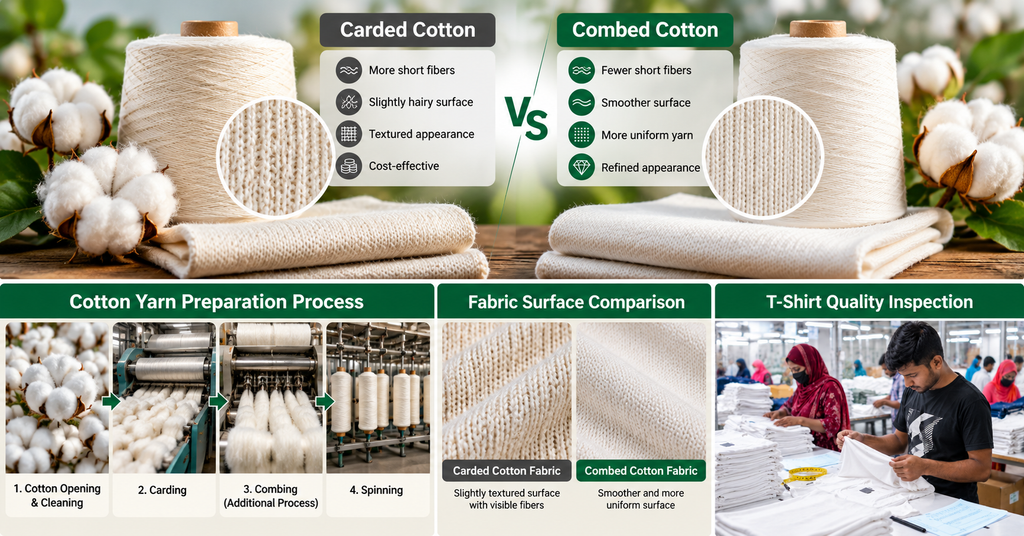
During carding, cotton fibers are opened, separated and partially aligned. The process also removes some impurities and neps, forming a continuous fiber strand known as sliver.
For conventional carded yarn, the material proceeds through subsequent preparation and spinning stages without the additional combing operation.
Because of this, carded yarn may retain a higher proportion of shorter fibers and display greater surface hairiness than comparable combed yarn.
Typical Characteristics
- Relatively economical processing
- Suitable for standard knitted fabric applications
- May contain more short fibers and neps
- Often has a more textured yarn surface
- Available for many commercially acceptable cotton garment programmes
Buyer Perspective
Carded cotton can be appropriate for promotional T-shirts, everyday apparel and price-sensitive collections.
However, a buyer should not approve carded yarn solely because its price is lower.
The finished fabric must still meet the agreed requirements for GSM, appearance, hand feel, dimensional stability and other relevant performance characteristics.
Buyer recommendation: Request a representative finished fabric swatch and confirm its construction before comparing supplier quotations.
2. What Is Combed Cotton?
Combed cotton undergoes an additional fiber preparation process after carding.
During combing, a proportion of shorter fibers, remaining neps and impurities is removed, improving fiber alignment and uniformity.
Under comparable spinning conditions, combed cotton yarn generally has lower hairiness, improved evenness and a smoother surface than carded cotton yarn.
Typical Characteristics
- Additional removal of short fibers
- More controlled fiber alignment
- Generally reduced yarn hairiness
- Potentially smoother knitted fabric appearance
- Additional processing cost
- Often selected for refined or premium cotton garments
Buyer Perspective
Combed cotton may be advantageous for premium private-label T-shirts, fashion basics and collections where fabric surface consistency is important.
It can also be worth considering when detailed decoration or a refined garment presentation is required.
However, buyers should not assume that the word combed guarantees softness, durability, shrinkage performance or printing quality.
Those characteristics must be assessed using the actual finished fabric.
Buyer recommendation: Compare combed and carded fabric samples with equivalent composition, GSM, construction and finishing wherever possible.
3. Combed vs Carded Cotton: Technical Comparison
| Technical Parameter | Carded Cotton | Combed Cotton |
|---|---|---|
| Preparation process | Carding without subsequent combing | Carding followed by combing |
| Short-fiber content | Generally higher | Generally lower |
| Fiber alignment | Less controlled | Generally improved |
| Yarn evenness | Depends on raw material and spinning | Often improved under comparable conditions |
| Yarn hairiness | Generally higher | Generally lower |
| Surface appearance | May be more textured | Often smoother |
| Processing cost | Generally lower | Generally higher |
| Typical buyer positioning | Standard and cost-sensitive apparel | Refined and premium apparel |
| Pilling performance | Requires finished-fabric testing | Requires finished-fabric testing |
| Shrinkage performance | Requires finished-fabric testing | Requires finished-fabric testing |
Technical note: These comparisons represent typical processing-related tendencies, not guaranteed product specifications.
Cotton grade, fiber length, spinning method, yarn count, knitting structure and finishing can materially affect the result.
4. How Yarn Quality Influences Knitted T-Shirt Fabric
4.1 Fabric Surface and Visual Appearance
Cotton yarn quality contributes to the appearance of single jersey, interlock and other knitted fabric constructions.
Short fibers and protruding fiber ends can influence yarn hairiness and fabric surface texture.
Combed yarn often produces a cleaner-looking fabric surface under comparable conditions.
For a brand developing a premium blank T-shirt, this may help achieve the desired visual presentation.
What buyers should check: Compare finished swatches under consistent lighting and inspect the surface for irregularities, excessive fuzz and visible yarn defects.
4.2 Hand Feel and Comfort
Combed cotton is frequently associated with a softer and smoother fabric feel.
However, yarn preparation is only one contributing factor.
Fiber fineness, yarn twist, knitted structure, finishing treatments and fabric relaxation can all affect softness and comfort.
A carded cotton fabric with suitable finishing may feel softer than a poorly processed combed cotton fabric.
What buyers should check: Approve the actual fabric hand feel and evaluate the garment after the intended washing procedure.
4.3 Pilling and Surface Fuzz
Pilling occurs when surface fibers become entangled into small balls during wear or laundering.
Yarn hairiness, fiber characteristics, fabric construction and finishing influence pilling behaviour.
Combing may reduce short-fiber content and yarn hairiness, but it cannot guarantee that a fabric will not pill.
For programmes where pilling resistance is important, buyers can request testing under an agreed method, such as ISO 12945-2.
What buyers should check: Agree on the test method, test conditions and acceptable rating before production.
4.4 Printing and Decoration
Surface consistency can influence the appearance of printed designs, especially detailed artwork.
A smoother fabric may support a more consistent visual result for certain printing applications.
Nevertheless, screen printing, DTG and DTF performance also depends on fabric preparation, printing chemistry, equipment settings, curing and finishing.
What buyers should check: Request a printed pre-production sample using the intended bulk fabric and artwork.
5. Does Combed Cotton Reduce Shrinkage?
A common misunderstanding is that combed cotton automatically has lower shrinkage.
This is not a reliable assumption.
Dimensional change depends on several manufacturing and care-related factors:
- Knitting tension and fabric relaxation
- Yarn and fabric construction
- Wet processing and finishing
- Compaction or other stabilization processes
- Washing and drying conditions
A combed cotton T-shirt can still experience unacceptable dimensional change if the fabric has not been appropriately processed.
Buyers should define their required shrinkage tolerance and use an agreed test procedure.
ISO 6330 provides domestic washing and drying procedures for textile testing, while ISO 5077 addresses determination of dimensional change after washing and drying.
Buyer recommendation: Ask for dimensional-change results from the intended finished fabric or garment, rather than accepting a shrinkage claim based only on yarn classification.
6. Yarn Type, Yarn Count and GSM: Three Different Specifications
These terms are frequently used together but describe different characteristics.
Yarn Type: Identifies the preparation method, such as carded or combed cotton.
Yarn Count: Describes yarn fineness. In the English cotton count system (Ne), a higher number indicates finer yarn.
GSM: Stands for grams per square metre and measures fabric mass per unit area.
For example, a buyer may request a 100% cotton, 200 GSM single jersey T-shirt.
That description alone does not establish whether the yarn is carded or combed, the yarn count, knitting density or finishing process.
Two fabrics with the same GSM can therefore differ in appearance, hand feel and performance.
Example: Comparing Two Supplier Quotations
Supplier A
- 100% cotton
- 200 GSM
- Carded yarn
- Single jersey
- Regular fit
Supplier B
- 100% cotton
- 200 GSM
- Combed yarn
- Single jersey
- Regular fit
These are illustrative specifications, not actual RioLeaf quotations.
Although both fabrics have the same composition and GSM, they are not necessarily technically equivalent.
A meaningful comparison should also consider yarn count, spinning system, fabric construction, finishing and performance requirements.
Buyer recommendation: Do not compare garment prices using composition and GSM alone.
Read Buyer Education Series 01 — Cotton Fiber Quality
7. Choosing the Right Cotton Yarn for Your T-Shirt Collection
Standard Promotional T-Shirts
Carded cotton may provide an appropriate balance of cost and acceptable quality when the fabric meets the buyer’s approved specification.
Everyday Private-Label Basics
Either carded or combed cotton may be suitable.
The decision should depend on the intended retail positioning, desired fabric hand feel and target manufacturing cost.
Premium Fashion and Streetwear T-Shirts
Combed cotton is often considered where a refined fabric surface and consistent appearance are priorities.
However, heavier GSM does not automatically require combed yarn, and premium positioning does not eliminate the need for fabric testing.
Printed Graphic T-Shirts
Yarn and fabric surface quality can affect print presentation.
Buyers should evaluate both the fabric and the finished print sample before selecting a bulk production option.
Commercial takeaway: The most suitable yarn is the one that meets the brand’s agreed product requirements at a commercially viable cost.
8. Buyer Approval Checklist Before Bulk Production
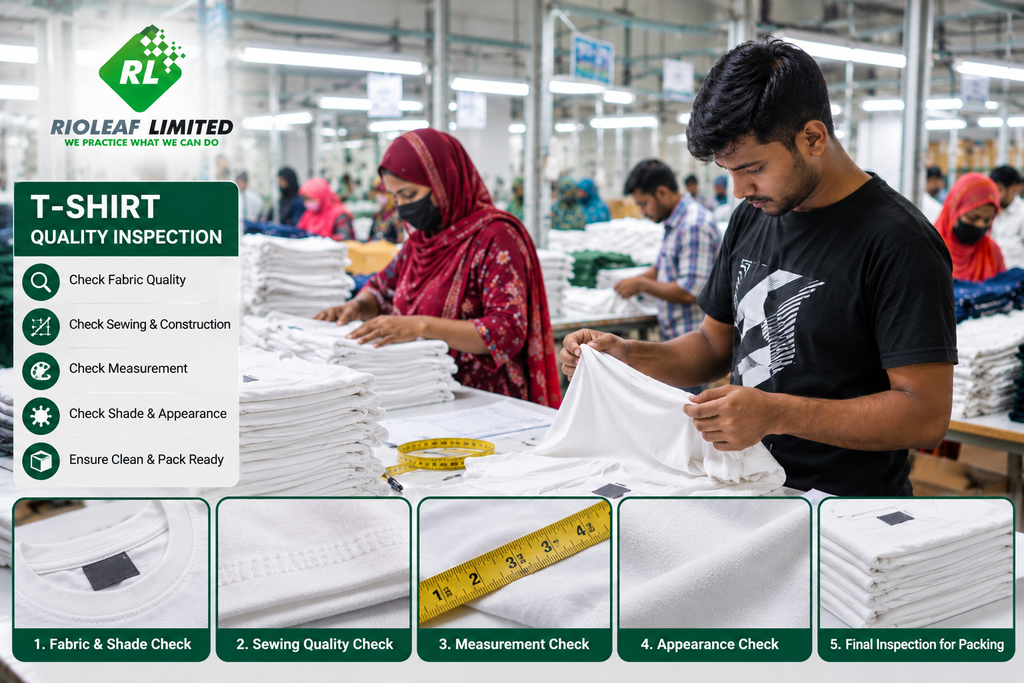
Before confirming a custom T-shirt order, buyers should request or approve the following information:
- Fiber composition and material specification
- Carded or combed yarn classification
- Yarn count and spinning system
- Knitted fabric construction
- Finished GSM and agreed tolerance
- Approved fabric colour and hand feel
- Dimensional-change requirements
- Pilling and colourfastness requirements, where applicable
- Approved printing or embroidery sample
- Pre-production sample and final quality acceptance criteria
For larger or repeat programmes, keeping an approved reference sample can help improve consistency between production orders.
Questions Buyers Should Ask Their Manufacturer
- Is the quoted cotton yarn carded or combed?
- What yarn count and spinning system are proposed?
- Is the quoted GSM measured on the finished fabric?
- Can a comparable fabric swatch be supplied?
- What dimensional-change and pilling requirements can be agreed?
- Will the bulk fabric match the approved sample?
- Are alternative yarn specifications available within the target budget?
These questions help buyers move from general marketing descriptions to measurable product specifications.
9. How RioLeaf Ltd. Supports Custom T-Shirt Development
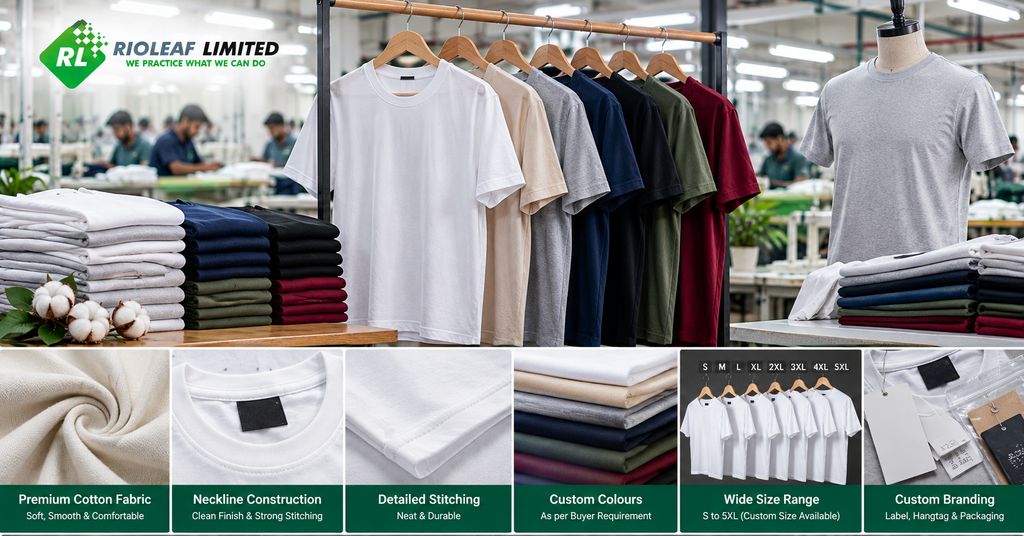
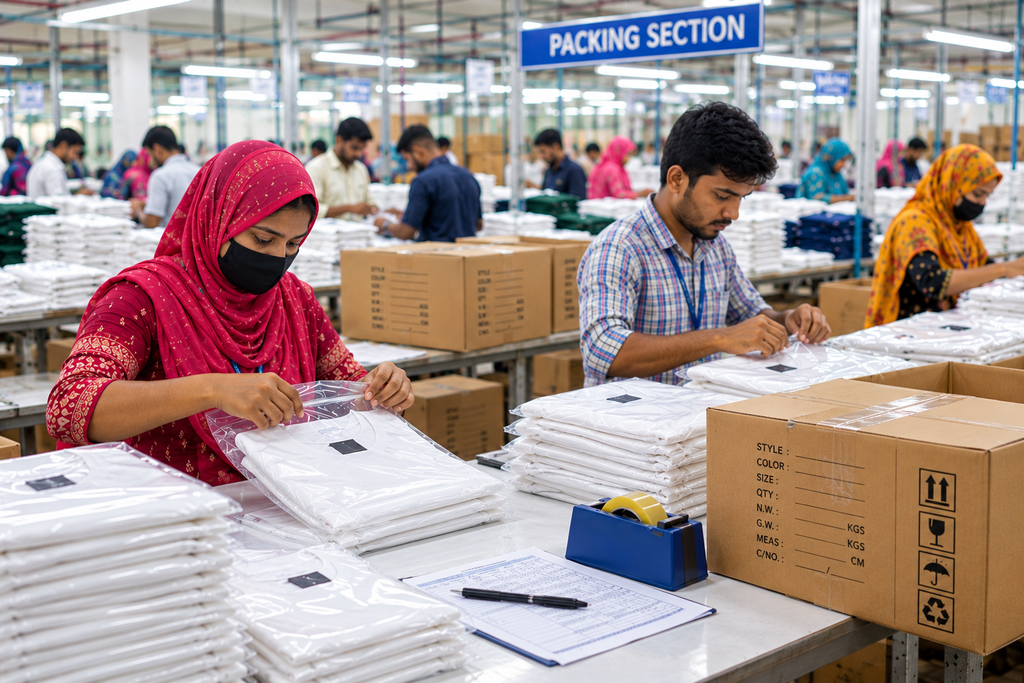
RioLeaf Ltd. is a Bangladesh-based knit garment manufacturer and exporter supporting OEM and ODM apparel programmes.
For custom T-shirt development, our team can review buyer specifications covering cotton composition, yarn selection, fabric GSM, knitting construction, fit, printing and private-label accessories.
Depending on project requirements and material availability, suitable local or imported fabric sourcing options can be evaluated.
Our garment customization capabilities include screen printing, DTG, DTF, embroidery, woven labels, care labels, hangtags and individual packaging.
Our approach emphasizes clear buyer specifications, representative samples and production requirements agreed before bulk manufacturing.
10. Frequently Asked Questions
Is combed cotton always better than carded cotton?
No. Combed cotton generally offers improved fiber uniformity, but the appropriate choice depends on the intended garment, quality requirements and budget.
Is combed cotton always softer?
Not necessarily. Combing can contribute to a smoother yarn, while final softness also depends on knitting and finishing.
Does combed cotton prevent pilling?
No. Finished-fabric pilling performance should be evaluated through suitable testing.
Can carded cotton be used for quality T-shirts?
Yes. Carded cotton can produce satisfactory garments when the material and manufacturing processes meet the agreed specifications.
Is 200 GSM combed cotton better than 200 GSM carded cotton?
Not automatically. GSM alone cannot establish overall quality. Yarn count, fabric construction, finishing and performance requirements must also be considered.
Why is combed cotton generally more expensive?
The additional combing process requires further processing and removes a portion of the fiber material, contributing to higher yarn production costs.
Conclusion: Better Yarn Decisions Begin With Better Specifications
The difference between combed and carded cotton matters, but yarn classification should never be the only factor in a sourcing decision.
Buyers should evaluate yarn preparation, fabric construction, finished GSM, appearance, performance requirements and approved samples together.
Clear technical specifications help apparel brands compare quotations more accurately, communicate quality expectations and reduce avoidable production misunderstandings.
Technical References
The following sources provide educational background and recognized textile testing references relevant to yarn preparation, fabric performance and quality evaluation. These references do not represent laboratory testing, certification or independently verified product performance claims by RioLeaf Ltd.
- CottonWorks — Textile Yarns Educational reference covering cotton yarn preparation, carding, combing and typical yarn-property differences.
- ISO 12945-2:2020 — Textiles: Determination of Fabric Propensity to Surface Pilling, Fuzzing or Matting — Part 2: Modified Martindale Method.
- ISO 6330:2021 — Textiles: Domestic Washing and Drying Procedures for Textile Testing.
- ISO 5077:2007 — Textiles: Determination of Dimensional Change in Washing and Drying.
- ASTM D3776/D3776M-20(2025) — Standard Test Methods for Mass Per Unit Area (Weight) of Fabric.
Editorial Note: All material comparisons are general technical guidance. Specific garment performance must be verified using appropriate samples, agreed specifications and relevant testing.
Planning Your Next Custom Cotton T-Shirt Collection?
Whether you are developing everyday cotton basics, premium private-label T-shirts or custom graphic garments, RioLeaf Ltd. can review your fabric and manufacturing requirements.
Share your preferred cotton yarn type, fabric composition, GSM, garment fit, artwork, estimated order quantity and quality expectations with our team.
COMING NEXT | BUYER EDUCATION SERIES — 03
Yarn Count Explained: How Ne Affects Knit Fabric GSM, Feel and T-Shirt Quality
Two cotton T-shirts can have the same GSM but use different yarn counts and knitting constructions. In our next buyer education guide, we will explain how yarn count works, why it matters and what apparel buyers should verify before approving fabric for bulk production.
Upcoming technical guide — publication date to be confirmed.